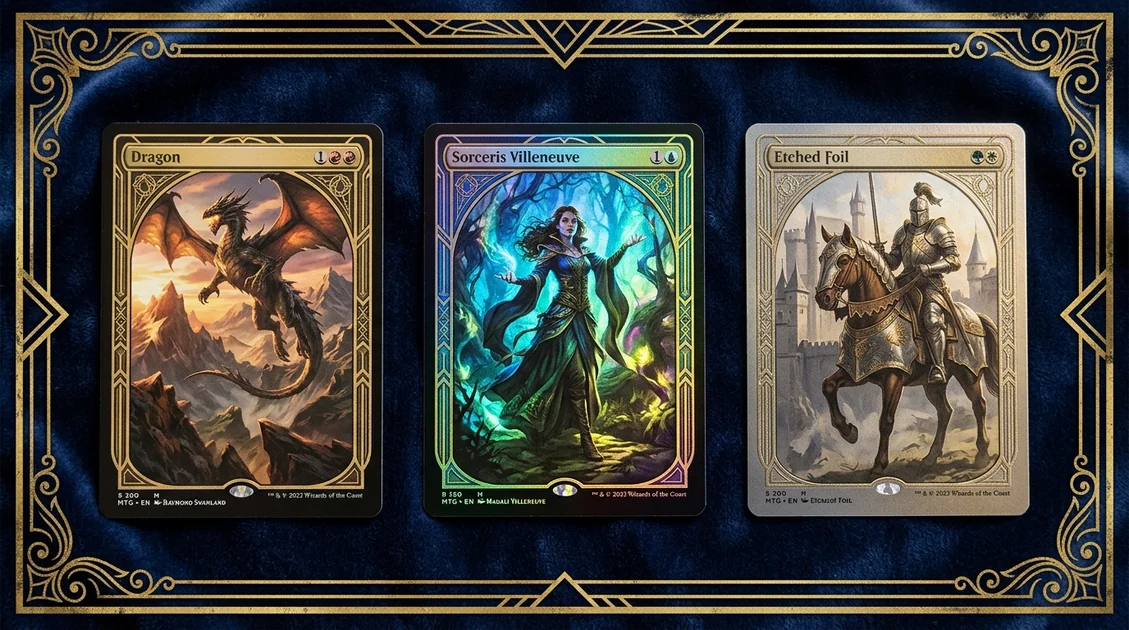
Foil vs Etched vs Non-Foil: The Magic: The Gathering Finish Guide
Every Magic card can come in multiple finishes — regular, foil, etched, gilded, textured, confetti. Here's what each one is, how they're made, and what they're worth.
Scrytics · May 21, 2026 · Updated April 19, 2026
Magic: The Gathering stopped being a game with one version of each card a long time ago. A single card in 2026 can exist in five or six different finishes, each with its own price point, supply curve, and collector community.
Here’s every finish Wizards currently prints, how they work, and what each signals on the secondary market.
Regular (Non-Foil)
What everyone calls “regular” — a standard cardstock Magic card with no reflective treatment. Printed in every set since 1993. 95% of all Magic cards in existence are non-foil regulars.
Price baseline: this is the reference. Other finishes quote as a multiplier of the regular.
Traditional Foil
Introduced in Urza’s Legacy (1999). A thin reflective coating applied to the entire card face. When you tilt it under light, the whole card shimmers with a rainbow spectrum.
How it’s made: during printing, a holographic foil sheet is laminated behind the card’s printing layer. The reflection you see is that sheet diffracting through the ink.
Price multiplier: 1.5× to 3× regular price for most cards. Much higher on popular Commander cards (often 3–5×) and iconic reprints.
Traditional foils curl (“pringle”) over time if stored unsleeved in humid conditions. The foil also scratches easily — avoid sleeve play without inner sleeves.
Etched Foil
Introduced with Commander Legends (2020). Only the non-art areas (borders, text box, type line) are foiled — the art remains matte. The foil pattern is textured like engraved metal, which is where the name comes from.
Visually distinct from traditional foil: you’ll see a sharp line where the shiny border meets the matte art.
Price multiplier: 1.3× to 2× regular. Often cheaper than traditional foil for the same card, because the “chase” status is lower.
Etched foils don’t pringle as badly as traditional because the foil is applied in patches rather than edge-to-edge.
Showcase Frame (Non-Foil and Foil)
Not technically a finish — it’s an alternate border treatment. Showcase frames are set-specific artistic redesigns:
- Ikoria — monster-themed jagged frames
- Kaldheim — rune-embossed frames
- Strixhaven — Japanese manga-style illustrations
- Innistrad: Crimson Vow — gothic horror frames with blood drip details
- Murders at Karlov Manor — art deco detective frames
Price multiplier: 1.5× to 3× regular. Showcase foil versions add another 1.5×–2× on top.
Showcase frames have become the preferred printing for Commander decks because they look distinct on the battlefield.
Borderless (Non-Foil and Foil)
The card art extends all the way to the edge of the card — no border. Introduced as a permanent treatment with Throne of Eldraine (2019).
Visually: the card looks like a piece of art with text overlaid, rather than a framed card.
Price multiplier: 2× to 4× regular. Borderless foils add another 1.5×–2×.
Borderless is the single most popular “premium” treatment in 2024–2026. The art-first aesthetic drives consistent demand.
Extended Art
The art extends horizontally across what would normally be the frame, leaving a thin text box at the bottom. Introduced with Throne of Eldraine.
Less dramatic than borderless but similarly premium. Typical in Collector Boosters.
Price multiplier: 1.8× to 3× regular.
Retro Frame (Old Border)
Reprints that use the 1993–2003 black-border frame style. Intended to make new cards look like they belong in the original Alpha/Beta aesthetic.
Introduced with Modern Horizons 2 (2021) and now a staple of Commander-oriented sets and collector products.
Price multiplier: 1.5× to 2.5× regular. Higher on iconic older cards getting retro reprints for nostalgia value.
Serialised
Numbered-of-X foil variants, usually 1/500, 1/250, or 1/100. A small “XXX/500” stamp is printed on the card.
Introduced with 30th Anniversary Celebration (2022) and now a standard Collector Booster chase.
Price multiplier: 10× to 100× regular. Low-numbered (001–005) copies add another 2–3× premium for collectors.
Serialised cards are the modern equivalent of the Reserved List — effectively capped supply, but printed in 2022 instead of 1993.
Textured Foil
A newer foil treatment where the foil pattern has a physical micro-texture, visible when you tilt the card. The foil appears to have depth, not just flatness.
Introduced in Double Masters 2022. Used sparingly on premium reprints.
Price multiplier: 2× to 5× regular.
Gilded Foil
Gold-tone foil with gold-coloured ink on the frame. Extremely rare; only on headline mythics in select sets.
Price multiplier: 5× to 15× regular.
Confetti Foil
Irregular multi-coloured foil sparkle effect. Used on Streets of New Capenna (2022) and select sets since.
Price multiplier: 2× to 4× regular.
Galaxy Foil
Introduced in Unfinity (2022). A nebula-like foil with no defined pattern, meant to evoke space.
Price multiplier: 2× to 5× regular.
Step-and-Compleat Foil
Phyrexia-themed foil pattern with a repeating Phyrexian step-compleat icon. Exclusive to Phyrexia: All Will Be One Collector Boosters.
Price multiplier: 3× to 6× regular.
Which finish is worth buying?
Depends on why you’re buying:
- For play: regular non-foil. Cheapest, doesn’t pringle, easy to sleeve. The premium finishes add zero gameplay value.
- For Commander display: borderless or showcase. They look best on the battlefield and in binders.
- For long-term value: serialised-numbered variants and Secret Lair exclusives. Supply is permanently capped, demand tends upward.
- For a complete collector set: one of each major finish. Often called “finish-complete” by set collectors — requires about 6 copies of each card to cover regular, foil, etched, showcase, borderless, and retro if all are printed.
Track finishes in Scrytics
Scrytics’ card detail pages (already live on the web) show every finish variant with its own 365-day price history. The iOS app’s collection tracker stores finish per copy, so you can say “I own 1 non-foil, 1 foil, 1 borderless” of a card and see the aggregate value move over time.
The number of finishes will keep growing. Wizards invents one or two new ones per year. If you buy premium finishes regularly, budget for surprise — this year’s hot showcase frame becomes next year’s unremarkable treatment as the next one launches.
Available now on iOS
Scan every card. Price every printing.
Scrytics is the Magic: The Gathering card scanner, collection tracker and price database for iPhone and iPad.