Magic: The Gathering Card Condition Guide
Near Mint, Lightly Played, Moderately Played, Heavily Played, Damaged — how the Magic grading scale works, how it maps to price, and how to grade your own cards accurately.
Scrytics · May 13, 2026 · Updated April 19, 2026
Condition is the second-biggest price variable in Magic: The Gathering after printing identity. A Near Mint dual land is worth $500. A Heavily Played one is worth $250. Same card, half the price.
Here’s how the Magic condition scale actually works, what dealers look for, and how to grade your own cards accurately without paying for PSA grading.
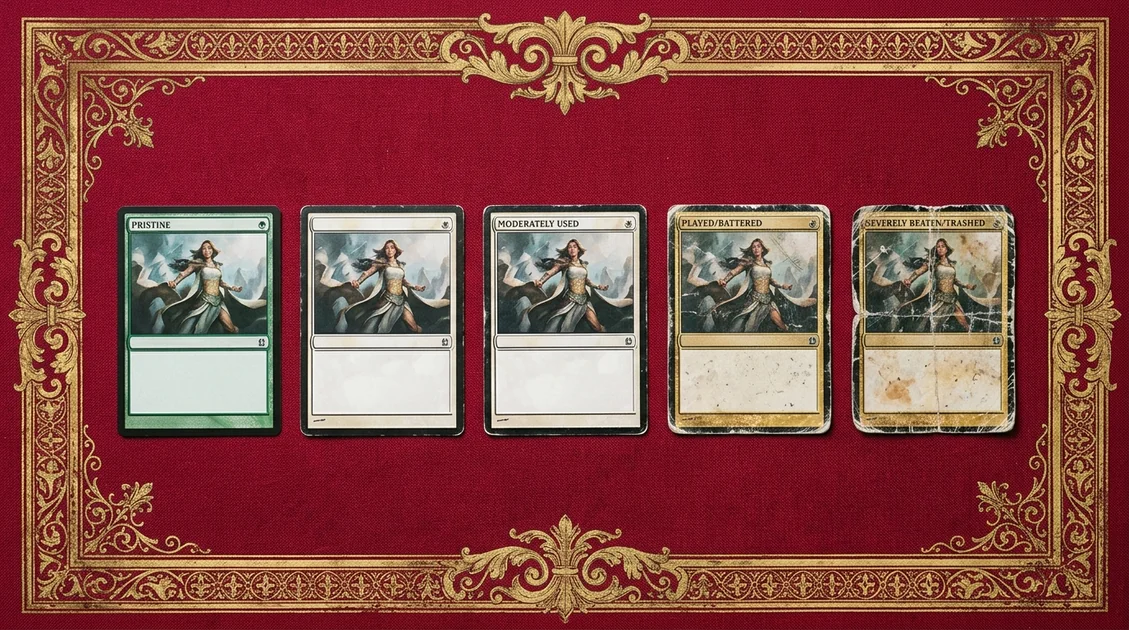
The five-grade scale
Magic uses a five-grade informal scale, standardised by TCGPlayer and adopted by most of the secondary market:
Near Mint (NM)
The card looks fresh out of the booster. Allowed:
- Minor edge whitening (hairline, barely visible)
- Light play shuffling that doesn’t affect the print
Not allowed:
- Visible edge wear, corner dings, scratches on the face, back whitening, creases, water damage
Price multiplier: 1.0× (the reference)
Lightly Played (LP)
Played but clearly cared for. Allowed:
- Light edge whitening visible in good light
- Slight corner wear not visible from across the table
- One or two surface scratches that don’t affect reading the card
Not allowed:
- Bends, creases, ink damage, water damage, white cornering
Price multiplier: 0.85× for most cards, down to 0.65× for premium cards where LP is effectively the floor
Moderately Played (MP)
Clearly played, visible wear. Allowed:
- Whitened edges
- Small corner dings
- Surface scratches
- Light shuffle wear on the back
- Minor creasing (not folded)
Not allowed:
- Playable-unsleeved card is basically never MP — you need sleeves
- No water damage, no ink markings
Price multiplier: 0.65× for commons/uncommons, 0.55× for rares
Heavily Played (HP)
Worn card. Allowed:
- Whitening on edges and corners
- Multiple creases
- Surface scratches that partially obscure art
- Minor water rings not obscuring text
Not allowed:
- Full creases across the middle
- Ink markings
- Card folded in half
Price multiplier: 0.45× for older/rarer cards, 0.30× for standard cards
Damaged (DMG)
Still identifiable and playable with sleeves. Signs:
- Creases, tears at edges
- Writing on the card
- Major water damage
- Significant surface damage
Price multiplier: 0.25–0.35× on cards that have any market value; usually bulk for anything under $5.
The backside test
The most common grading mistake: forgetting to check the back of the card. Many cards look Near Mint from the front and Moderately Played from the back, because sleeve-shuffling wears the back more than the front.
Always grade from both sides. The lower grade wins.
The fluorescent-light test
Edge whitening is the biggest condition signal and the hardest to see under warm indoor light. To grade properly:
- Use a white light source (daylight or 5000K LED)
- Hold the card at a 30° angle to the light
- Rotate slowly — any edge wear shows up as a white rim
Dealers use this test every time. If you’re selling, do it first so you set realistic prices.
The finger-nail test
Run a fingernail across the face of the card. You’ll feel:
- Tiny vertical scratches (LP)
- Horizontal scratches (HP — usually from binder page rubbing)
- Deep scratches you can feel (DMG)
For foils, never do this — foils scratch permanently from even light pressure.
Foil condition quirks
Foils are harder to grade because:
- Foils scratch with micro-abrasions not visible until you tilt the card
- Foils “pringle” (curl like a Pringles chip) — a slight curl is acceptable, anything you can see from across the table is MP or worse
- Foil edges whiten dramatically compared to non-foils
A lightly scratched foil is typically priced at 75–85% of NM value. A pringled foil, 50–60%.
Old-card condition quirks
Alpha and Beta cards have their own scale. Because they’re 30+ years old and supply is fixed, dealers use:
- Alpha/Beta NM (MP by normal standards) — traded as NM because true NM 1993 cards are vanishingly rare
- Alpha/Beta Played — the standard trading grade, equivalent to modern HP
If you own an Alpha or Beta card, the grading scale is essentially compressed one step upward from modern cards. What would be LP by modern standards trades as NM for old cards.
When to pay for professional grading
Professional grading (PSA, BGS, CGC) is worthwhile only on high-value cards where the grade premium is significant:
- Any card worth $300+ in NM condition
- Alpha/Beta rares regardless of base value
- Scarce promos where a PSA 10 commands 2–3× PSA 9
Grading costs $15–$50 per card plus shipping. The card gets sealed in a tamper-evident case with a numerical grade (1–10 scale). The card is now worth whatever the graded market says it is, which is usually more than raw for NM+ cards and less than raw for played cards.
Don’t send MP or HP cards to grading — the numerical grade will be 6 or lower and that commands a discount relative to raw.
Track card condition in Scrytics
Scrytics’ collection tracker (shipping) stores condition per copy, not per card. If you own four Underground Seas, you can mark them individually as NM, LP, NM, and MP. The collection value calculation uses per-copy conditions — so your binder total reflects real condition, not optimistic estimates.
That’s the scale. Grade honestly, store properly, and your $500 cards stay $500 cards. Grade optimistically, ship carelessly, and they drift into the $300 range quietly.
Available now on iOS
Scan every card. Price every printing.
Scrytics is the Magic: The Gathering card scanner, collection tracker and price database for iPhone and iPad.