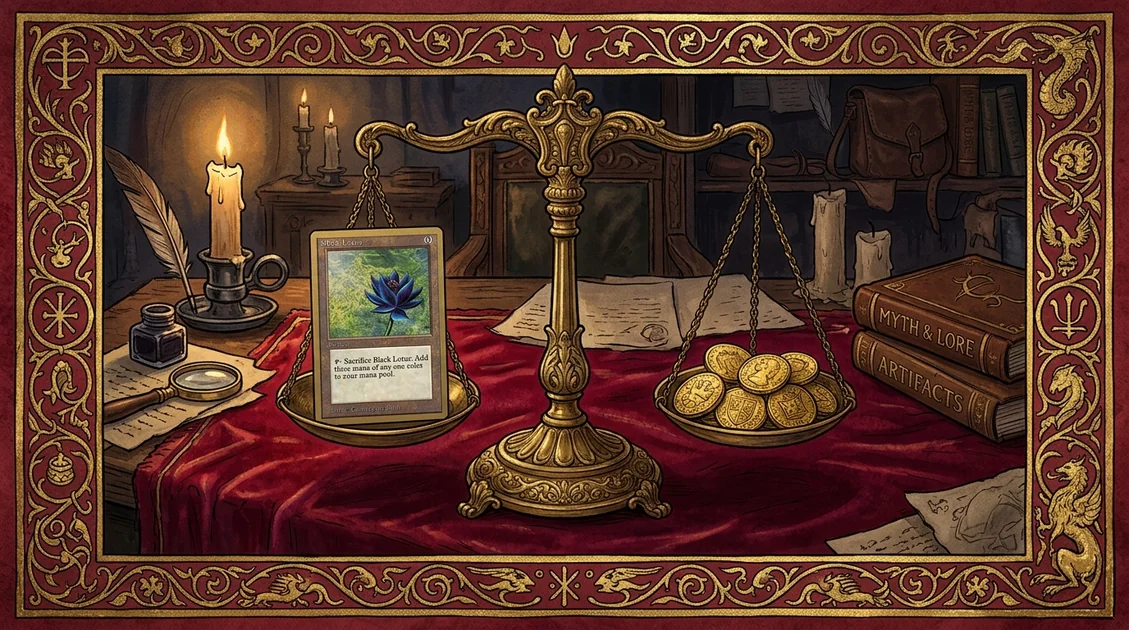
How to Tell If a Magic: The Gathering Card Is Worth Money
Most Magic cards are worth pennies. A few are worth thousands. Here's how to tell the difference — rarity, format, printing, and the signals that drive a card's price.
Scrytics · May 1, 2026 · Updated April 19, 2026
Someone hands you a binder of Magic cards. Maybe an attic find, maybe an estate, maybe your cousin’s old collection. You want to know: is there anything in here worth money?
The honest answer: probably one or two cards, and everything else is bulk. But the one or two can be worth a lot — and knowing what to look for takes about five minutes.
The four signals that a Magic card is worth money
1. The set is old (1993–1994)
Magic’s first three sets — Limited Edition Alpha (August 1993), Limited Edition Beta (October 1993), and Unlimited (December 1993) — plus the 1994 releases (Arabian Nights, Antiquities, Legends, The Dark) are where the money lives.
The giveaway: black border on an Alpha card’s cornering is rounded (Beta and later are squared). Set symbols appeared starting with Arabian Nights — if there’s no set symbol at all on the lower right of the art, the card is Alpha, Beta, or Unlimited.
2. The card is on the Reserved List
Wizards of the Coast maintains a public Reserved List — cards they have promised never to reprint. Because the supply is permanently fixed while the player base keeps growing, Reserved List cards drift upward in price over time.
Reserved List cards are roughly: anything from Alpha–Fourth Edition that isn’t a basic land, plus specific cards from early expansions. If you have Alpha/Beta rares, they’re on the Reserved List. The Power Nine (Black Lotus, the five Moxes, Ancestral Recall, Time Walk, Timetwister) are all Reserved List.
3. The card is played in a major format
A card is worth money when it’s played competitively. The formats that drive prices:
- Commander — by far the largest player base. Cards like Jeweled Lotus, [Mana Crypt], [Dockside Extortionist] trade in the $50–$200 range because every new Commander deck is a potential new buyer.
- Modern — fetch lands, shock lands, key combo pieces. Prices tend to be lower but more stable.
- Legacy / Vintage — niche but intense. Dual lands ($500–$2,000 each) are the headline cards.
- Pauper — some commons pushed to $10–$30 because the format restricts to common rarity only.
- Standard — spikes and crashes every two years as sets rotate. Don’t pay spike prices.
If a card was rare in a set, but never played anywhere, it’s bulk even if it’s rare.
4. It’s a special printing
Modern Magic prints multiple versions of the same card. The same Sol Ring might appear as:
- Regular Commander deck (worth $1)
- Collector booster foil (worth $8)
- Showcase frame (worth $15)
- Promo with alternate art (worth $25)
- Serialised 1/500 variant (worth $400)
The giveaway is the border and frame treatment. Showcase frames (ornate, themed), borderless (art bleeds to edge), extended-art (thin rules-text box), retro frame (1993-era style reprints) all command premiums. Serialised cards have a small X/Y number printed on them.
Cards that look expensive but aren’t
A few types of cards that people consistently mistake for valuable:
- Foils of bulk commons. A foil bulk common is worth maybe $0.50. Not $50.
- Early set reprints with Core Set symbols. 7th Edition, 8th Edition, 9th Edition, 10th Edition printings look old but were mass-produced and are cheap.
- “Tapped out” older rares that were never played. Rare doesn’t mean valuable — only played or Reserved.
- Tokens, emblems, and double-sided cards. Visually striking but usually $0.
How to check actual prices
- Scrytics — scan the card on iPhone, confirm the printing and see its current price. The web database at scrytics.com/cards also lets you search by name.
- Scryfall — scryfall.com, free, shows USD/EUR/TIX and full rulings.
- CardMarket — cardmarket.com for European players; the reference for the EUR secondary market.
- TCGPlayer — tcgplayer.com for North American prices; “Market” is the rolling average, “Low” is the cheapest listing.
Always cross-check two sources before pricing a card, especially for anything over $20. The markets diverge on obscure cards and foils, and eBay “sold” listings will tell you what someone actually paid versus what sellers are asking.
The 80/20 of valuation
80% of a collection’s value usually sits in 20% of its cards — often just 5%. For most collections:
- The Reserved List rares and dual lands are the jackpot.
- The most-recent 2–3 Standard sets have some $20–$60 cards.
- Commander staples from the last 5 years have $10–$50 cards.
- Everything else is bulk (worth about $5/kg in bulk sales).
If you find a card you think is worth money, scan it, cross-check two prices, check its condition (Near Mint commands a premium, Moderately Played takes 25–40% off), and only then decide what to do with it.
And if it’s a black-bordered Alpha card with no set symbol — stop scrolling and put it in a top-loader immediately.
Available now on iOS
Scan every card. Price every printing.
Scrytics is the Magic: The Gathering card scanner, collection tracker and price database for iPhone and iPad.