How to Spot Fake Magic: The Gathering Cards
Counterfeit Magic cards are everywhere. Here's how dealers tell fakes from real — the light test, the bend test, the rosette pattern, and the set-specific tells.
Scrytics · April 21, 2026 · Updated April 19, 2026
Counterfeit Magic: The Gathering cards are a real problem in 2026. The Chinese proxy market has gotten sophisticated enough that low-effort fakes fool casual buyers, and a specific tier of “Asian premium proxies” can fool dealers at a glance.
Here’s the detection playbook professional dealers use.
The light test (blue core)
Magic cards use a specific paper stock with a blue core layer sandwiched between the white front and black back layers. If you tear a real Magic card (don’t — it’s just the principle), you’ll see a thin blue stripe in the middle.
You don’t need to tear anything. Hold the card up to a strong white light and look at the edge. A real card has a faint blue-grey cast visible in the cardstock. A fake is uniformly white-to-grey or has a different coloured core.
This is the single most reliable test. Counterfeiters rarely source the specific Magic paper stock, and when they do, the colour is off.
The bend test (the one dealers actually use)
Bend the card gently between your fingers — a real Magic card flexes easily and returns to flat. Fakes often:
- Feel stiffer (heavier cardstock)
- Feel softer (thinner paper)
- Crease where a real card would flex
- Return with a slight permanent bend
Don’t aggressively bend valuable cards. Light pressure along the long axis is enough to feel the difference.
The rosette pattern
Under magnification (a jeweler’s loupe, 10× is standard), a real Magic card’s ink shows a characteristic rosette pattern — tiny dots arranged in a circular offset pattern. This is the signature of CMYK offset printing used by Cartamundi (Magic’s printer since 1993).
Fakes printed on inkjet or laser printers show either:
- A straight grid of dots (inkjet)
- A mottled solid ink (laser)
- A rosette pattern with wrong dot sizes (cheap offset)
A 10× loupe costs $5 on Amazon. If you collect anything valuable, you need one.
Face-to-back alignment
Real Magic cards are printed with exact face-to-back alignment. Fakes, especially older ones, have a slight offset where the back print is shifted 1–3mm left, right, up, or down relative to the face.
Test: stand the card upright on its edge. Look at the top edge. On a real card, the white part of the face meets the white border of the back symmetrically. On a fake, you’ll see asymmetric white margins.
The watermark test (modern cards)
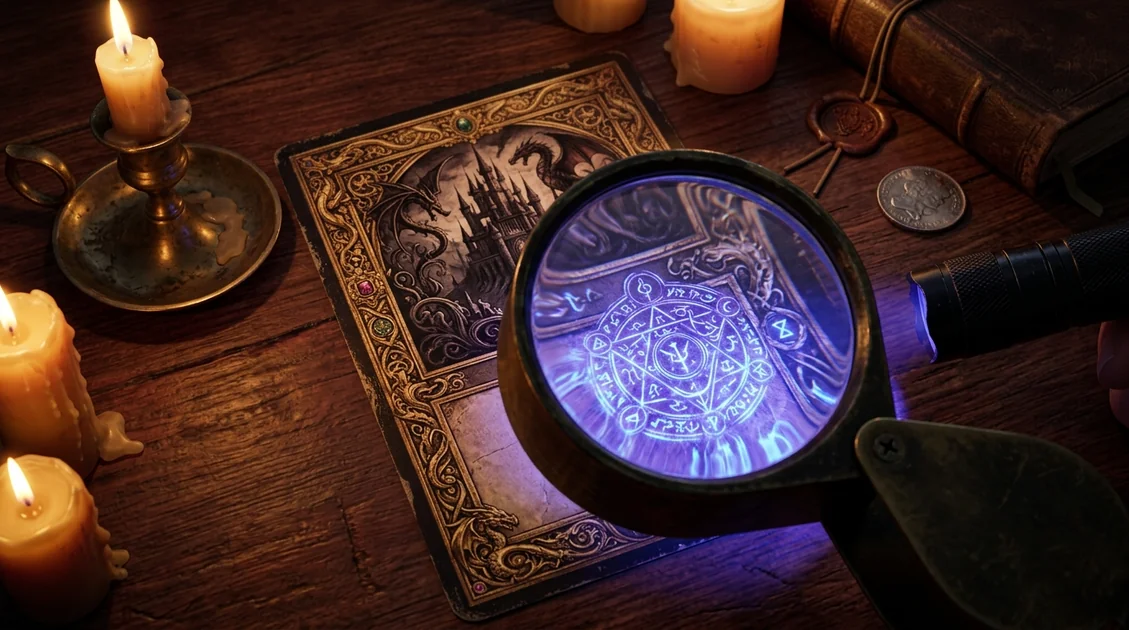
From around 2018 onwards, Magic cards have a very faint watermark pattern visible under UV light — typically the card frame elements repeated at the edges. Hold a card under a UV flashlight and the pattern fluoresces.
Older cards (pre-2018) don’t have this, so the UV test only applies to modern cards. But for any recent Commander product, Secret Lair, or Masters set, a missing UV pattern is a red flag.
Set-specific tells
Certain sets have specific counterfeit “tells” the community has catalogued:
Alpha (1993): the black border on real Alpha cards has rounded corners — not square like Beta. Fakes get this wrong surprisingly often.
Beta and Unlimited: the set symbol placement is specific. Fakes tend to print the symbol slightly too large or too high.
Italian Legends (1994): real Italian Legends cards have a specific print-tell where the copyright line uses a slightly different font than English Legends. Almost all fakes reproduce the English copyright.
Arabian Nights (1993): the card backs on real Arabian Nights are a slightly darker ink than later sets. Fakes usually reproduce the standard modern back colour.
Collector Boosters (2019+): real collector-booster foils have specific foil patterns per set. Fakes often use a generic rainbow foil that doesn’t match the actual pattern for the set.
The smell test
Genuinely — Magic cards have a faint ink smell, especially new cards. Fakes from inkjet printers have a different, chemical smell. Laser-printed fakes have a burnt-toner smell. Counterfeiters know this and try to “age” cards with household methods, but the smell tell usually remains.
When to be suspicious
Classic warning signs that should trigger a full authentication:
- Deal is too good. A Revised Underground Sea at $200 when the market price is $500 is either played or fake.
- Seller has no history. eBay accounts with <20 feedback selling Power Nine cards are fake until proven otherwise.
- Seller refuses close-up photos. A real dealer will happily provide macro photos of edges, corners, and the face.
- “Altered” or “remakes” in the listing. Those are fakes with extra wording.
- Bulk lot of high-value cards for a suspiciously low price. Counterfeiters bundle fakes into “collection” sales.
If you suspect a fake
- Don’t play it in a tournament. Tournament-legal requires authentic cards.
- Get a second opinion. Post high-resolution photos of front, back, and edges in r/mtgfinance or a Discord. Experienced collectors can often spot fakes from photos.
- Request a return. If you bought recently on eBay, TCGPlayer, CardMarket, or a similar platform, a buyer-protection claim for counterfeit is nearly always upheld.
- Keep the fake. Some collectors buy fakes for reference. Don’t resell it — selling counterfeits knowingly is fraud.
Proxies are different from fakes
One important distinction: proxies and fakes are different categories.
A proxy is a card clearly marked as a copy — often with “PROXY” printed on it, or from a known proxy supplier like MPC (Make Playing Cards) — used for casual play. These are legal in many Commander pods and Old School events. Selling a proxy as a proxy is fine.
A fake is a counterfeit trying to pass as real. Selling a fake as real is fraud.
The overlap is where it gets dicey: “Chinese premium proxies” from certain suppliers are sold as “authentic duplicates” and buyers sometimes try to resell them as real cards. If you’re unsure whether what you’re about to buy is a proxy or a fake, the seller’s listing should make it explicit. If it doesn’t, assume it’s a fake.
Scrytics helps — but doesn’t replace authentication
Scrytics’ scanner identifies the card identity — which set, printing and finish — but it doesn’t tell you whether the physical card is authentic. That’s still a human job with a loupe, a UV light and experience.
For anything over $50, the authentication test takes two minutes. Do it.
Available now on iOS
Scan every card. Price every printing.
Scrytics is the Magic: The Gathering card scanner, collection tracker and price database for iPhone and iPad.